The word surreal means strange, dreamlike, or seemingly unreal. It is used for unusual experiences, places, images, stories, and situations that do not feel completely normal.
Today, people use “surreal” in everyday conversations, social media posts, movies, literature, art, and online chats.
Also Read Gyatt Meaning
Meaning & Definition of Surreal
Primary Meaning:
Surreal means strange or dreamlike in a way that seems disconnected from ordinary reality.
It often describes something that feels impossible, bizarre, unexpected, or difficult to believe.
Secondary Meaning:
Surreal can also describe something that resembles the style or ideas of Surrealism, an artistic and literary movement known for unusual combinations, dream imagery, and irrational scenes.
Simple Definition:
In simple words:
Surreal means so strange or unusual that it feels like a dream.
For example, watching snow fall on a hot summer beach might feel surreal.
Examples:
- “Winning the competition felt surreal.”
- “The empty city looked surreal at night.”
- “That movie had a surreal ending.”
- “Meeting my favorite singer was a surreal experience.”
- “The painting has a surreal atmosphere.”
Background & Origin of the Word Surreal
The word surreal comes from Surrealism, the avant-garde artistic and literary movement associated with dreamlike and unexpected imagery.
Etymological sources trace surrealism to French surréalisme. The French term was coined around 1917 and later became closely associated with André Breton and the Surrealist movement launched in the 1920s.
The English adjective surreal appeared later as a back-formation from surrealism or surrealist. Etymological sources date its modern English use to the 1930s.
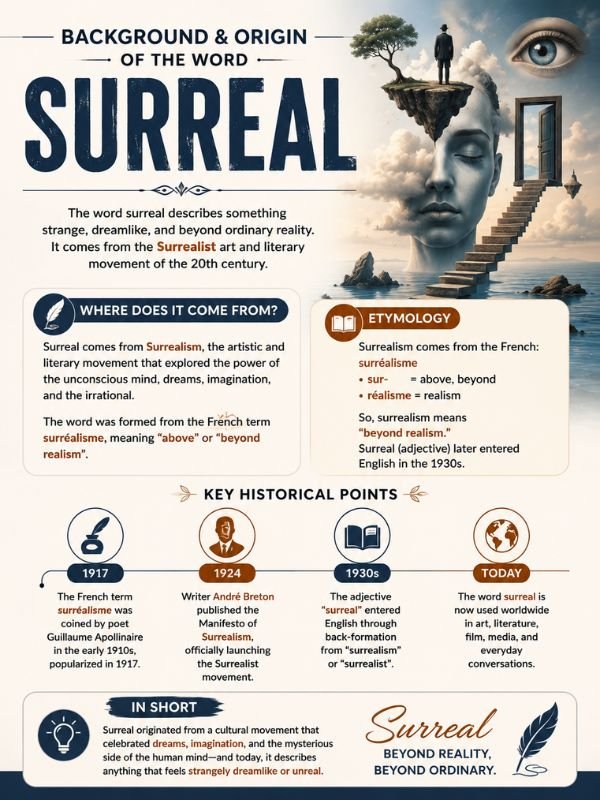
Key Historical Points:
- 1917: The French term surréalisme was coined.
- 1924: André Breton published the Manifesto of Surrealism.
- 1930s: “Surreal” entered English usage.
- Today: The word is widely used beyond art to describe everyday experiences.
Surreal is good or bad
Surreal can be either positive, negative, or neutral.
It depends on the situation. A beautiful sunset can feel surreal, while a frightening or confusing event can also be described as surreal.
For example:
- Positive: “Winning the award was surreal.”
- Negative: “The accident created a surreal atmosphere.”
- Neutral: “The empty streets looked surreal.”
Surreal feeling meaning
A surreal feeling is the sensation that something happening around you does not seem completely real.
It can happen during major life events, unexpected situations, emotional moments, or extremely unusual experiences.
Surreal etymology
Surreal developed from Surrealism, which comes from French surréalisme. The French formation combines sur- meaning “beyond” with réalisme, meaning “realism.”
Surreal place meaning
A surreal place is somewhere that looks or feels unusual, dreamlike, or disconnected from normal surroundings.
For example, a fog-covered abandoned city could be described as a surreal place.
Meaning surrealism
Surrealism is an artistic and literary movement that combines unusual, irrational, or impossible elements.
It often explores dreams, imagination, the unconscious mind, and unexpected combinations.
Meaning surrealism
In simple terms, Surrealism is art or writing that presents dreamlike or impossible ideas in unusual ways.
It became an important 20th-century cultural movement.
Meaning of surrealist
A surrealist can be an artist, writer, or creator associated with Surrealism.
The word can also describe something that follows the style or principles of Surrealism.
Also Read Namaste Meaning
Surreal paintings
Surreal paintings often combine objects, people, places, or ideas that would not normally appear together.
Salvador Dalí’s dreamlike imagery is one of the best-known examples associated with Surrealist art.
These paintings may create feelings of confusion, wonder, mystery, or dreamlike reality.
Another word for surreal
Depending on context, alternatives for surreal include:
- Dreamlike
- Unreal
- Bizarre
- Strange
- Fantastic
- Unusual
- Extraordinary
- Otherworldly
- Dreamy
- Absurd
However, these words are not always exact synonyms.
Usage of Surreal in Different Contexts
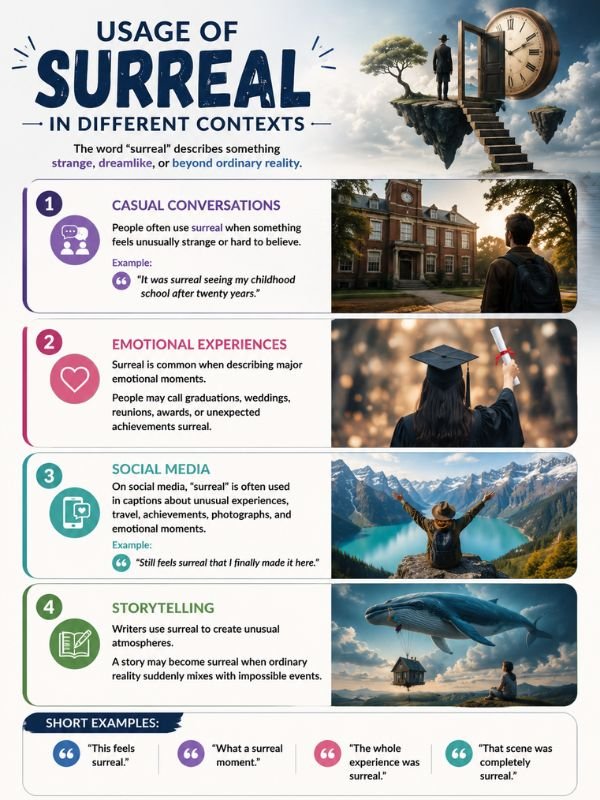
1. Casual Conversations
People often use surreal when something feels unusually strange or hard to believe.
Example: “It was surreal seeing my childhood school after twenty years.”
2. Emotional Experiences
Surreal is common when describing major emotional moments.
People may call graduations, weddings, reunions, awards, or unexpected achievements surreal.
3. Social Media
On social media, “surreal” is often used in captions about unusual experiences, travel, achievements, photographs, and emotional moments.
Example: “Still feels surreal that I finally made it here.”
4. Storytelling
Writers use surreal to create unusual atmospheres.
A story may become surreal when ordinary reality suddenly mixes with impossible events.
Short Examples:
- “This feels surreal.”
- “What a surreal moment.”
- “The whole experience was surreal.”
- “That scene was completely surreal.”
Also Read BTA Meaning
Meanings of Surreal Across Platforms
The basic meaning stays similar online, but the context can change.
| Platform | Common Use |
| Emotional or unusual experiences | |
| Photos, achievements, travel, life moments | |
| TikTok | Strange videos, unexpected events, memes |
| Snapchat | Casual reactions and unusual situations |
On WhatsApp, someone might say “That was surreal” after sharing an unexpected personal experience.
Instagram users often use surreal in captions for dreamlike photographs, travel locations, achievements, or emotional milestones.
TikTok
TikTok commonly uses the word for strange videos, unexpected situations, unusual edits, and bizarre real-life moments.
Snapchat
On Snapchat, surreal usually appears as a casual reaction to something unusual, funny, beautiful, or difficult to believe.
Surreal in Other Fields (Technical & Scientific Usage)
1. Psychology
Surreal is not generally a formal psychological diagnosis.
However, people may use the word to describe experiences that feel dreamlike, disconnected, or difficult to process.
2. Art & Literature
In art and literature, surreal has a more specific connection to Surrealism.
Surrealist works often combine unrelated objects and ideas to create dreamlike or irrational scenes.
3. Film & Media
A film can be called surreal when it uses unusual imagery, strange events, nontraditional storytelling, or dreamlike environments.
The term is often used for movies that deliberately challenge normal ideas of reality.
4. Everyday Language
In everyday English, surreal has become much broader.
Someone can call an ordinary real-life event surreal simply because it feels unbelievable or strangely dreamlike.
Common Misconceptions & Mistakes
Mistake 1: Thinking it means “fake”
Surreal does not necessarily mean fake.
Something can be completely real but still feel surreal because it is strange or difficult to believe.
Mistake 2: Confusing with “unreal”
Surreal and unreal can overlap, but they are not identical.
Unreal can mean imaginary or not real, while surreal usually emphasizes a strange, dreamlike quality.
Mistake 3: Overusing it
Calling every unusual thing surreal can weaken the word.
Use it when something genuinely feels dreamlike, bizarre, extraordinary, or disconnected from normal expectations.
Similar Terms & Alternatives
Here are some useful alternatives:
- Dreamlike — resembling a dream.
- Bizarre — very strange or unusual.
- Unreal — seeming imaginary or surprisingly extraordinary.
- Strange — unusual or unfamiliar.
- Fantastic — extraordinary or imaginative.
- Absurd — unreasonable or wildly illogical.
How to Respond When Someone Says “It’s Surreal”
When someone says “It’s surreal,” they usually mean that something feels unusually strange, emotional, amazing, or hard to believe.
Your response depends on the situation.
Chat Examples:
Them: “I finally met my favorite actor. It was surreal.”
You: “I can imagine! That must have been amazing.”
Them: “This whole situation feels surreal.”
You: “Yeah, it really does. Everything happened so unexpectedly.”
Differences Between Surreal and Similar Words
| Word | Main Meaning | Example |
| Surreal | Strange and dreamlike | “The scene looked surreal.” |
| Unreal | Not real or incredibly surprising | “The view was unreal.” |
| Strange | Unusual or unfamiliar | “That was a strange experience.” |
| Bizarre | Extremely unusual | “The story was bizarre.” |
Surreal vs Unreal
Surreal focuses on a dreamlike or bizarre quality.
Unreal can mean something is imaginary, false, or extremely impressive.
Surreal vs Strange
Strange simply means unusual.
Surreal suggests something more unusual, dreamlike, or disconnected from ordinary reality.
Surreal vs Bizarre
Bizarre emphasizes extreme unusualness.
Surreal often adds a dreamlike or irrational quality.
Surreal Meaning in Online Conversations & Dating Apps
In online conversations, surreal often describes an unexpected or emotionally powerful experience.
On dating apps, someone might use it after an unusual first meeting, unexpected connection, or memorable date.
Examples:
- “Meeting someone like you here feels surreal.”
- “That first date was honestly surreal.”
- “It’s surreal that we actually met after talking for months.”
In these examples, surreal can express excitement, disbelief, or emotional intensity.
Popularity & Trends Over Time
The word surreal has moved far beyond its original artistic context.
Today, people use it in everyday conversations, news reporting, social media captions, entertainment reviews, and online discussions. Dictionary examples show it being used for everything from major events to unusual scenes and experiences.
Why it’s trending:
- It describes emotional experiences clearly.
- It works well for social media captions.
- It fits unusual photographs and videos.
- It can describe both positive and negative moments.
- Its meaning is easy to understand from context.
FAQs
What do surreal mean?
Surreal means strange, dreamlike, or seemingly unreal, especially when unusual elements appear together.
what surrealism means?
Surrealism is a 20th-century artistic and literary movement focused on unusual, dreamlike, irrational, and often impossible imagery.
Is surreal positive or negative?
Surreal can be positive, negative, or neutral. The meaning depends on the experience being described.
Can surreal mean fake?
Not exactly. Something can be real but still feel surreal because it seems strange, dreamlike, or difficult to believe.
Is surreal slang?
No. Surreal is a standard English adjective, although people frequently use it informally in everyday speech and online conversations.
Conclusion
The surreal meaning is simple: something is surreal when it feels strange, dreamlike, bizarre, or disconnected from normal reality.
The word has roots in the Surrealist art and literary movement of the 20th century. Over time, it developed into a common everyday expression for unusual or unbelievable experiences.
Today, you can see surreal used in conversations, Instagram captions, TikTok videos, movies, books, art, and personal stories.
So when someone says “This feels surreal,” they usually mean that the moment feels so unusual or extraordinary that it almost seems like a dream.


1 thought on “Surreal Meaning Explained Definition, Origins, Usage & Real-Life Contexts”