
The word Namaste is one of the best-known greetings associated with India and South Asian culture. You may hear it in everyday conversations, yoga classes, spiritual settings, movies, and social media.
But what does Namaste actually mean?
In simple terms, Namaste is a respectful greeting that literally means something close to “I bow to you” or “salutations to you.” It comes from Sanskrit and combines namas, meaning bow or salutation, with te, meaning “to you.”
Today, Namaste can express respect, welcome, humility, gratitude, or farewell. Its meaning can also become more spiritual depending on the context.
Meaning & Definition of Namaste
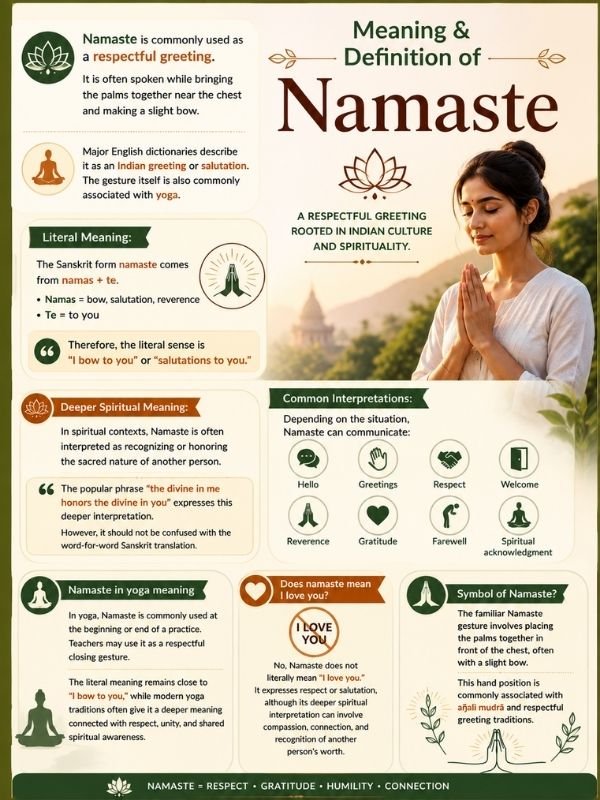
Namaste is commonly used as a respectful greeting. It is often spoken while bringing the palms together near the chest and making a slight bow.
Major English dictionaries describe it as an Indian greeting or salutation. The gesture itself is also commonly associated with yoga.
Literal Meaning:
The Sanskrit form namaste comes from namas + te.
- Namas = bow, salutation, reverence
- Te = to you
Therefore, the literal sense is “I bow to you” or “salutations to you.”
Deeper Spiritual Meaning:
In spiritual contexts, Namaste is often interpreted as recognizing or honoring the sacred nature of another person.
The popular phrase “the divine in me honors the divine in you” expresses this deeper interpretation. However, it should not be confused with the word-for-word Sanskrit translation.
Also Read BTA Meaning
Common Interpretations:
Depending on the situation, Namaste can communicate:
- Hello
- Greetings
- Respect
- Welcome
- Reverence
- Gratitude
- Farewell
- Spiritual acknowledgment
Namaste in yoga meaning
In yoga, Namaste is commonly used at the beginning or end of a practice. Teachers may use it as a respectful closing gesture.
The literal meaning remains close to “I bow to you,” while modern yoga traditions often give it a deeper meaning connected with respect, unity, and shared spiritual awareness.
Does namaste mean I love you?
No, Namaste does not literally mean “I love you.” It expresses respect or salutation, although its deeper spiritual interpretation can involve compassion, connection, and recognition of another person’s worth.
Symbol of Namaste?
The familiar Namaste gesture involves placing the palms together in front of the chest, often with a slight bow.
This hand position is commonly associated with añjali mudrā and respectful greeting traditions.
Which languages use Namaste?
Namaste is used widely in South Asia and is especially familiar in Hindi and other Indian-language contexts.
Related forms such as Namaskar and Namaskaram are also used in different regions and languages.
Background & Origin of Namaste
Namaste has ancient Sanskrit roots.
The expression appears in early Sanskrit literature, including Vedic texts. Historical evidence also connects related forms of salutation with Indian religious and cultural traditions.
The modern English word entered wider English usage much later. Etymological sources record the greeting in English-language sources by the late 19th century, while the noun describing the gesture became established in the 20th century.
Its long history helps explain why Namaste can carry both an everyday and a spiritual sense.
Also Read YN Meaning
Usage in Different Contexts
1. Daily Life
Namaste can be used when meeting someone respectfully.
It may be appropriate when greeting elders, guests, teachers, or people in situations where a courteous greeting is expected.
2. Spiritual Settings
The word can appear in Hindu religious contexts, meditation, yoga, and other spiritual practices.
Here, the gesture may emphasize humility, reverence, peace, or spiritual connection.
3. Social Conversations
Namaste can also be used in ordinary social interaction.
It does not always indicate a religious statement. In many Indian contexts, it functions simply as a respectful greeting.
4. Digital Communication
Online, people may type “Namaste” or use the 🙏 emoji to communicate greetings, respect, thanks, or appreciation.
The intended meaning depends heavily on the conversation.
Examples:
- “Namaste, nice to meet you.”
- “Namaste everyone.”
- “Namaste 🙏”
- “Thank you for your guidance. Namaste.”
- “Namaste, see you tomorrow.”
Meanings Across Platforms
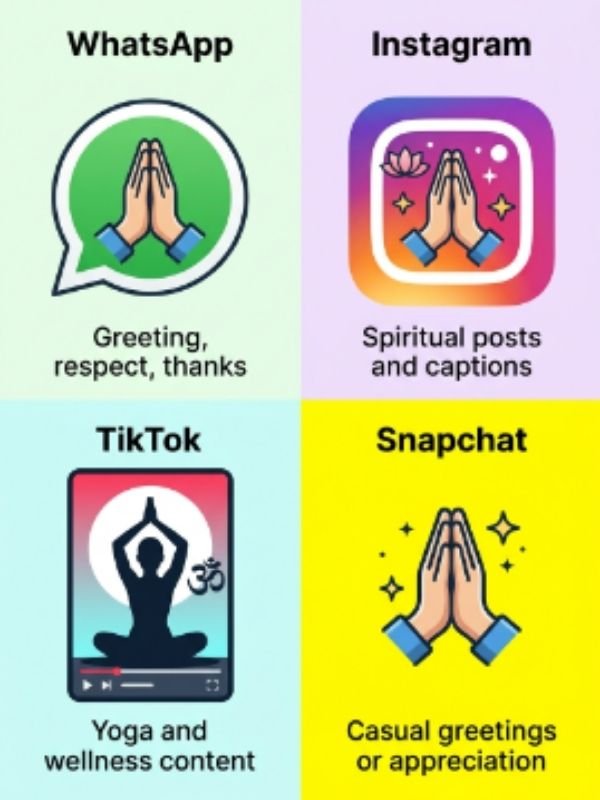
| Platform | Common use of Namaste |
| Greeting, respect, thanks | |
| Captions, comments, spiritual posts | |
| TikTok | Yoga, wellness, cultural content |
| Snapchat | Casual greetings or appreciation |
On WhatsApp, Namaste is often used in personal messages, group greetings, festival wishes, or respectful conversations.
The 🙏 emoji is also frequently used alongside the word.
Instagram posts may use Namaste in yoga, travel, Indian culture, spiritual, or inspirational content.
It can also appear simply as a respectful greeting.
TikTok
On TikTok, Namaste is often connected with yoga, meditation, spirituality, Indian culture, and wellness content.
Its meaning can be serious or playful depending on the video.
Snapchat
On Snapchat, Namaste is generally informal.
A user might send it as a greeting, a respectful response, or alongside a cultural or spiritual image.
Other Field Meanings (Technical/Scientific Use)
Namaste does not have one widely recognized technical or scientific definition.
If you see NAMASTE written as an acronym in a specialized field, organization, research project, or technical document, its meaning may be completely different.
Context should always be checked before assuming it refers to the traditional greeting.
Common Misconceptions & Mistakes
Misconception 1: It just means hello
Namaste can mean hello, but its use is broader.
It can also express respect, greeting, salutation, or farewell depending on the situation.
Misconception 2: Only Hindus use it
Namaste has important Hindu and broader South Asian cultural connections, but it is not limited to Hindu religious settings.
It is also used as a social greeting in India and elsewhere.
Misconception 3: It is outdated
Namaste remains widely recognizable and is used in everyday life, yoga, international events, social media, and cultural settings.
Its global visibility has increased significantly through yoga and wellness culture.
Mistake: Using it casually in inappropriate formal settings
Namaste is respectful, but context still matters.
If you are unsure about cultural expectations, observe how others greet each other and follow the setting rather than treating Namaste as a universal replacement for every greeting.
Similar Terms & Alternatives
Depending on the language and situation, alternatives include:
- Namaskar — a related respectful salutation.
- Namaskaram — a regional form used in South India.
- Hello — a general English greeting.
- Salaam — a greeting with Arabic and Islamic linguistic roots.
- Good morning — a time-specific English greeting.
- Goodbye — a common English farewell.
How to Respond to Namaste
The simplest response is usually “Namaste” in return.
You can also respond with a smile, a slight bow, or the same palms-together gesture when appropriate.
Examples:
Person A: “Namaste.”
Person B: “Namaste. Nice to meet you.”
Or in a message:
Person A: “Namaste 🙏”
Person B: “Namaste 🙏”
Differences From Similar Words
Namaste vs Hello
Namaste is a traditional South Asian salutation associated with respect and a palms-together gesture.
Hello is a general English greeting with no equivalent cultural gesture.
Namaste vs Goodbye
Namaste is primarily a greeting, but it can also function as a respectful farewell in some contexts.
“Goodbye” specifically signals departure.
Namaste vs Salaam
Namaste and Salaam can both function as respectful greetings, but they have different linguistic and cultural histories.
Namaste comes from Sanskrit, while Salaam comes from Arabic and is strongly associated with Muslim greeting traditions.
Relevance in Online Conversations & Dating Apps
Namaste is not normally a romantic expression.
On dating apps, someone might use it to open a conversation respectfully or to show cultural interest. However, it should not automatically be interpreted as flirting.
If someone sends “Namaste 🙏”, the safest interpretation is usually a polite greeting unless the surrounding conversation suggests something more.
Popularity & Trends Over Time
Namaste has moved far beyond its traditional South Asian setting.
Its international visibility grew through travel, yoga, meditation, wellness culture, popular media, and global cultural exchange. It also became particularly visible in international public life as a non-contact greeting during the COVID-19 pandemic.
Yoga has played a major role in its modern global recognition. In many Western yoga classes, Namaste is used at the end of a session, although this modern practice has also generated discussions about cultural context and appropriation.
Frequently Asked Questions:
What does Namaste literally mean?
Namaste literally means “I bow to you” or “salutations to you,” from Sanskrit namas and te.
Is Namaste religious?
Namaste has roots in Sanskrit and Hindu traditions, but it is also widely used as a social greeting and is not necessarily a religious statement.
What is the English word for “namaste”?
There is no perfect one-word English equivalent; depending on context, it can mean “hello,” “greetings,” “salutations,” or “I bow to you.”
Can I use Namaste in daily conversation?
Yes. Namaste can be used as a respectful everyday greeting, particularly in Indian and South Asian cultural contexts.
Why do people say Namaste in yoga?
Many yoga teachers use Namaste to close a class as a gesture of respect, gratitude, or shared presence.
Is Namaste used worldwide?
Yes. Namaste is now widely recognized outside South Asia, especially through yoga, wellness, travel, media, and international cultural exchange.
Conclusion
The Namaste meaning goes beyond a simple “hello.”
At its linguistic core, Namaste means something close to “I bow to you” or “salutations to you.” It comes from Sanskrit and has a long history within South Asian cultural and religious traditions.
Today, it can be used as a greeting, farewell, gesture of respect, or expression of gratitude. In yoga and spiritual settings, it may carry a deeper sense of connection and reverence.
The most important point is context. Namaste can be a simple everyday greeting in one situation and a deeply meaningful spiritual expression in another.Namaste Meaning: Complete Guide to Origin, Usage & Cultural Significance.


1 thought on “Namaste Meaning: Complete Guide to Origin, Usage & Cultural Significance”